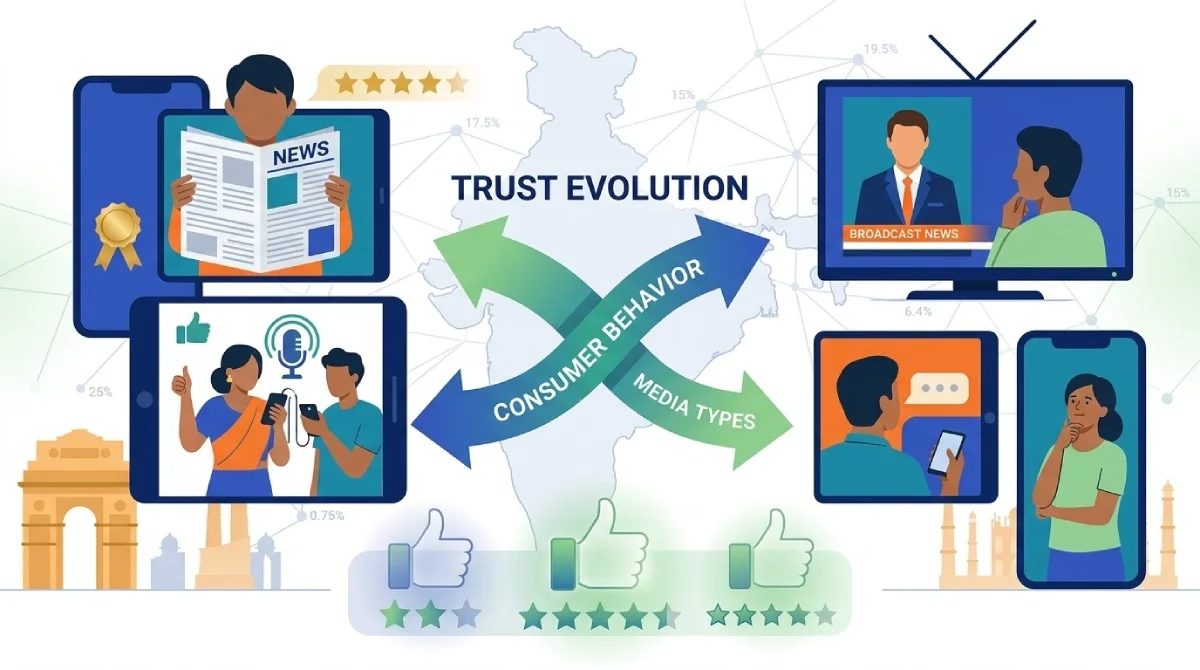
Consumer trust and media: what’s really changing in India
Ten years ago, a feature in a national daily or business channel signalled credibility. Media visibility meant legitimacy, not just for investors, but for consumers as well.
Today, that equation has shifted.
Consumers are still paying attention, but how they decide what to trust has changed. We have worked on campaigns where mainstream coverage delivered less impact than a single, well-placed mention in a regional newsletter. We have also seen influencer fatigue dull the effect of high production collaborations.
So, what is actually changing, and how should brands respond?
The source still matters, but the format matters just as much
The question consumers are asking is no longer where did this brand appear, but why should I believe this now.
Context has become critical. A long form founder podcast can build more credibility than multiple short news mentions. An expert led carousel explaining real product impact can outperform a standard launch release.
This is no longer a volume game.
It is a relevance game.
Social proof now has layers
Trust is no longer built only through reviews or testimonials.
Consumers observe behaviour. Who is actually using the product. How a brand responds to comments. What employees and former employees say publicly. Whether an influencer relationship feels genuine or transactional.
In one campaign, everything landed as planned from a media perspective. But what truly moved sales was an unplanned user generated video that resonated organically after the launch.
In one campaign, everything landed as planned from a media perspective. But what truly moved sales was an unplanned user generated video that resonated organically after the launch.
Smart brands understand that trust is being shaped continuously, across platforms, voices and moments.
One size narratives no longer work
This is especially visible in the D2C space. The same copy and visuals are often used across press, social, retail and influencer channels. The outcome is predictable. Diminishing impact.
What works now is layered storytelling.
A macro narrative for national media
A culture first adaptation for regional outlets
Expert explainers for social platforms
Customer voices for community channels
The core message stays consistent, but trust is built through how and where it is delivered.
Brands that listen earn trust faster
We now track earned sentiment as closely as earned coverage. The conversations around a campaign often reveal more than the coverage itself.
For a personal care brand, post campaign listening informed the next phase of communication. Consumers noticed because feedback was reflected quickly and visibly.
If your media strategy still mirrors how things worked in 2018, it is not just outdated. It is invisible.
Trust today is built where attention lives. That means rethinking how, when, and through whom your brand shows up. We help brands navigate this shift by focusing less on chasing coverage and more on earning belief.
About Author
Vikram Kharvi
CEO, Bloomingdale PR
With over 27 years of experience, I specialize in transforming business challenges into opportunities through innovative marketing and PR strategies.

Corporate PR in India: what CXOs should expect from their agency
I have spent enough time in boardrooms to know when a PR brief is not really about press. It is about reputation, control and influence. Sometimes it is about protecting legacy. Other times, it is about reshaping it. Corporate PR in India has matured, but one thing...

Luxury isn’t dying. It’s just whispering now
If you have been watching fashion over the last eighteen months, the shift is unmistakable. Loud is out. Logos are shrinking. Colour palettes are softening. The mood is slower, more deliberate, more assured. What we are seeing is the rise of quiet luxury. And this is...
Media relations in India: what still works and what’s changed
I remember a time when media relations meant meeting a journalist for coffee, sending a press note, and waiting a week for coverage to appear in print. Today, everything moves faster. But the fundamentals have not disappeared. They have evolved. Founders still ask us,...